


Everyday care
Gum disease treatment in North York
Care for bleeding gums and gum disease, matched to its stage. We’ll explain what we find and the cost before you decide.
Gum care
Gums that bleed when you brush are easy to ignore, because early gum disease often has no other obvious signs. Caught early, it can be reversed. We check your gums at every check-up and treat gum disease with care matched to its stage.
Two stages
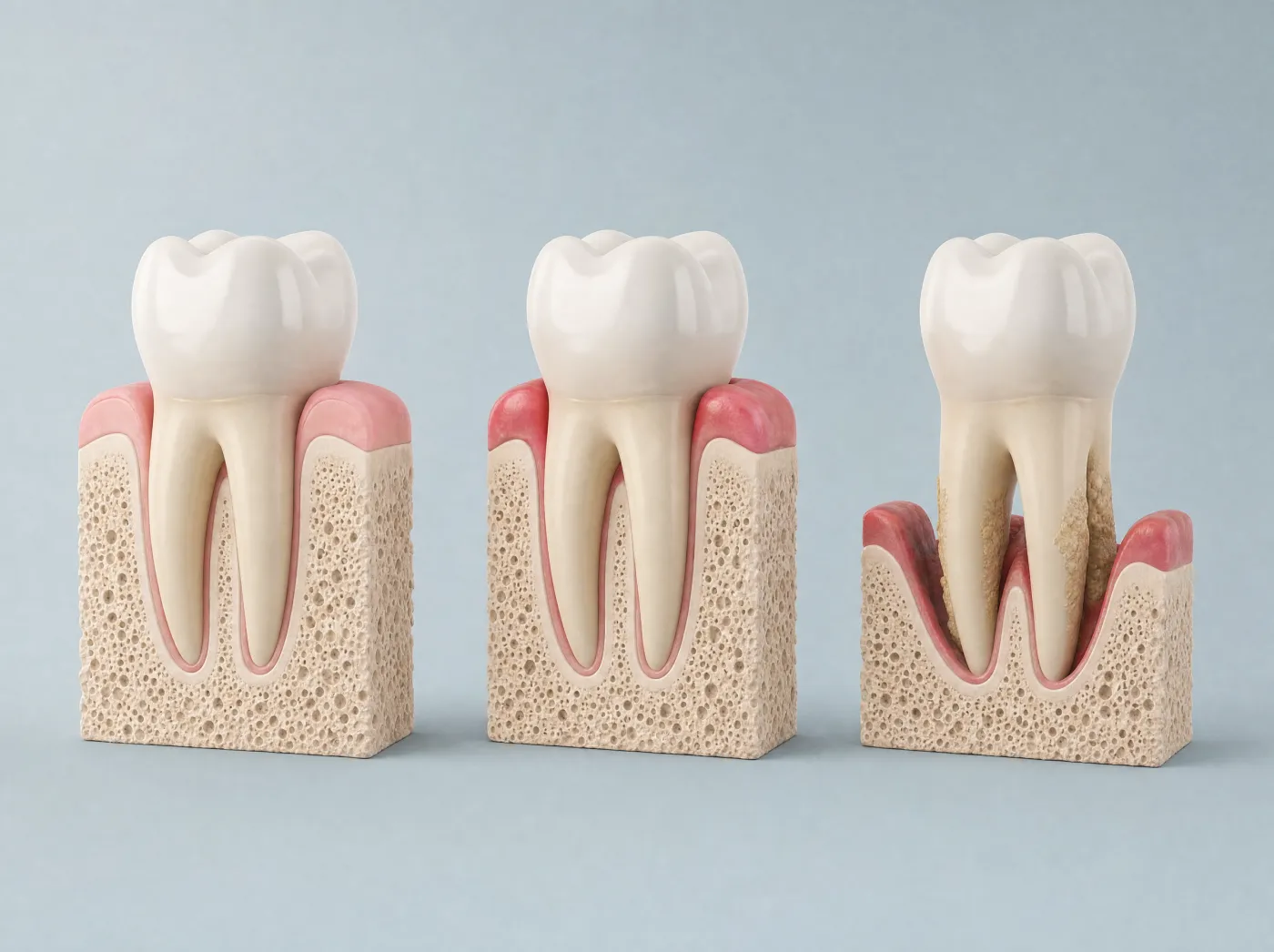
What is gum disease?
Gum disease starts when plaque builds up along and under the gumline. It has two stages.

Step by step
What to expect
Gum assessment
We measure the small space between each tooth and its gum, check for bleeding and recession, and may take X-rays to look at the bone. We explain what we find and the plan.
Your health
Does gum health affect diabetes?
For people with diabetes and gum disease, treating the gum disease may also help improve blood sugar control.8 It works alongside your usual diabetes care, not in place of it. Tell us about your health history so we can plan your care.
Good to know
What can treatment do?
Treatment can stop gum disease from getting worse, but bone that has already been lost does not usually grow back on its own. Results depend a great deal on home care and on not smoking. For more serious gum disease that does not respond to regular care, your dentist may refer you to a periodontist, a gum specialist with at least three extra years of training.9
If the gums do not heal as hoped after a deep cleaning, gum surgery may be considered.6
Fees
Cost and insurance
Fees depend on your treatment, and we never charge more than the Ontario Dental Association (ODA) fee guide. We bill your insurance directly and accept the Canadian Dental Care Plan (CDCP). With CDCP, you pay only your CDCP co-payment, or nothing if CDCP covers 100% of your care, and we never charge the difference between the CDCP and ODA fee guides. You'll know the cost before you decide. See insurance, direct billing and CDCP.
Visit our studio
Find us on Sheppard Avenue East.
Address
175 Sheppard Avenue East
North York, ON M2N 3A6
Getting here
About a 10-minute walk from Sheppard–Yonge station.
Parking
Free underground parking is available.
Hours
- Monday–Friday
- 9 am–8 pm
- Saturday
- 9 am–4 pm

Book a check-up.
New to seesmile? Start with our new-patient visit.
A gum assessment is needed to decide which treatment is right for you.
Questions
Questions, answered.
Sources
- Canadian Dental Association. Gingivitis. https://www.cda-adc.ca/for-the-public/understanding-your-oral-health/complications/gingivitis
- American Dental Association, MouthHealthy. Gum disease. https://www.mouthhealthy.org/all-topics-a-z/gum-disease
- Canadian Dental Association. Gum disease. https://www.cda-adc.ca/for-the-public/understanding-your-oral-health/complications/gum-diseases
- American Dental Association, MouthHealthy. Gum disease (risk factors and signs). https://www.mouthhealthy.org/all-topics-a-z/gum-disease
- American Academy of Periodontology. Gum disease risk factors. https://www.perio.org/for-patients/gum-disease-information/gum-disease-risk-factors/
- American Academy of Periodontology. Non-surgical treatments. https://www.perio.org/for-patients/periodontal-treatments-and-procedures/non-surgical-treatments/
- Sanz M, et al. Treatment of stage I–III periodontitis: the EFP S3 level clinical practice guideline. Journal of Clinical Periodontology 2020;47 Suppl 22:4–60. PMID 32383274. https://pubmed.ncbi.nlm.nih.gov/32383274/
- Simpson TC, Clarkson JE, Worthington HV, et al. Treatment of periodontitis for glycaemic control in people with diabetes mellitus. Cochrane Database of Systematic Reviews 2022, CD004714.pub4. https://www.cochrane.org/CD004714/ORAL_treating-gum-disease-help-control-blood-sugar-levels-people-diabetes
- Canadian Dental Association. Gum diseases FAQs. https://www.cda-adc.ca/for-the-public/faqs/gum-diseases-faqs